

Which Elicit alternatives should researchers evaluate?
Elicit is designed for scientific research workflows, including discovering papers and organizing extracted evidence. An alternative may help if you need a different search approach, a citation-context tool or a way to map related papers. No single product automatically provides a complete systematic review.
Three tools for different stages
| Tool | Distinct use | Main limitation to examine |
|---|---|---|
| Consensus | Ask a question and explore relevant scholarly literature | Whether the answer represents the studies accurately |
| Scite | Inspect citation context and research evidence | A citation classification does not replace reading the study |
| ResearchRabbit | Explore networks of papers and authors | Results depend on starting papers and database coverage |
These products can complement Elicit as well as replace individual steps. For a structured extraction table, test the actual extraction features of any proposed replacement before switching.
Example: compare literature discovery
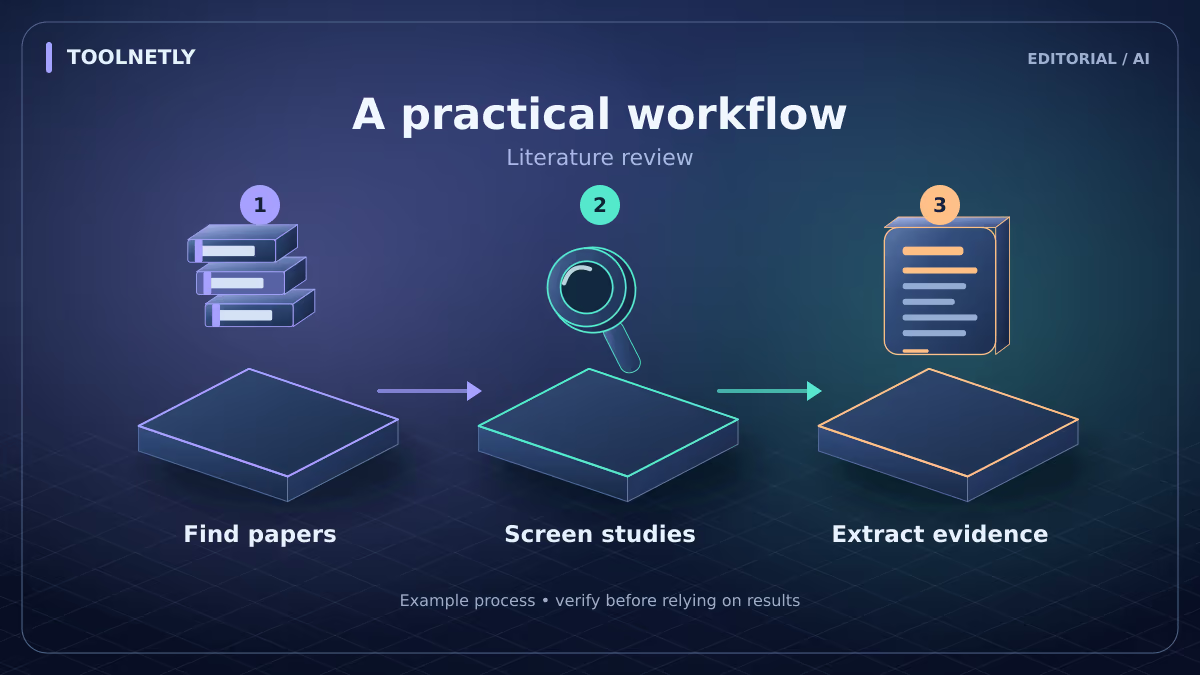
Find papers → Screen studies → Extract evidence
Suppose you are studying whether urban tree cover affects outdoor heat exposure. Begin with several papers identified through a library search. Record their titles, DOIs and inclusion criteria. Use Consensus to explore related research questions, ResearchRabbit to follow connections between relevant publications, and Scite to inspect how key studies have been cited.
Keep a separate search log and evidence table. If an article measures air temperature but your question concerns pedestrian thermal comfort, do not silently treat the outcomes as equivalent. Read the methods and check whether the sample or setting matches your question.
How to judge the results
Prepare a small known set of ten relevant papers. Compare how many each tool retrieves, whether it introduces irrelevant studies, and how much work is needed to export or verify the records. Review full-text access limitations and any errors in extracted numbers. These checks are a better starting point than comparing vendor accuracy claims that may use different evaluation methods.
For a formal literature review, retain your database search strings and inclusion decisions. Follow your institution's disclosure and research integrity rules. Check licensing and privacy before uploading unpublished manuscripts.
Cost and selection
Review free or paid access, search limits, full-text availability, export formats and institutional subscriptions on the official sites. ResearchRabbit is worth considering for discovery; Scite for citation context; Consensus for question-driven exploration. Elicit may remain appropriate for structured review workflows.
Read AI tools for research and AI tools for students for related examples.
Understand the four stages of a literature review
A literature review begins with a question and a search plan, not with a generated summary. After defining the question, researchers discover potentially relevant papers, screen them according to their criteria, extract evidence and synthesize the findings. A tool that is strong at discovery may not be designed for structured screening. A citation-analysis service may reveal useful context without offering the same extraction workflow as Elicit.
For that reason, the most appropriate alternative may be a combination of tools rather than one replacement. The goal is to improve a specific stage of the review while preserving a transparent method.
Consensus for question-led exploration
If you are beginning a research project and want to understand what kinds of studies have investigated a question, a question-oriented academic search service may be useful. Start by expressing the research question in terms of a population, a factor or intervention, and an outcome. For example, ask whether spaced practice improves retention in adult language learning.
Use the results to identify terminology and candidate studies. Do not accept a generated synthesis until you have read the relevant publications. Record whether the papers actually concern adult learners, how the researchers measured retention and whether the comparison group differs in other ways. A study involving a different age group may provide background without answering your exact question.
Scite for understanding citation context
A highly cited paper is not necessarily a reliable or directly relevant paper. Researchers cite previous work for many reasons: to describe a method, discuss a disagreement or provide background. Citation context can help you identify how a finding has been used, challenged or extended.
Choose one study from your review and inspect later publications that refer to it. Read the surrounding passages yourself and classify what the later author is claiming. If a later paper criticizes a measurement method, do not interpret that as evidence that the entire earlier finding is false. A citation-context tool is a way to discover these discussions, not a substitute for evaluating their arguments.
ResearchRabbit for finding connected work
Citation and author networks can reveal publications that a keyword search misses. Begin with several relevant papers from different research groups rather than a single favorite study. Explore related publications and compare their relevance to your inclusion criteria.
If the network leads to many papers from one journal or research group, deliberately search other sources. A discovery network reflects the starting collection and available records. It may miss new papers, isolated research groups or work outside the dominant citation network.
Elicit as the baseline for structured extraction
If your current Elicit workflow organizes papers and extracts study characteristics into a table, evaluate that function directly before migrating. Ask any proposed replacement to reproduce a few columns from a known set of papers. Important columns might include sample size, design, intervention duration and outcome measurement.
If another product primarily answers questions or maps literature, it may complement Elicit rather than replace the extraction stage. Preserve your evidence table in a format you can use independently of the platform.
Match the alternative to your review stage
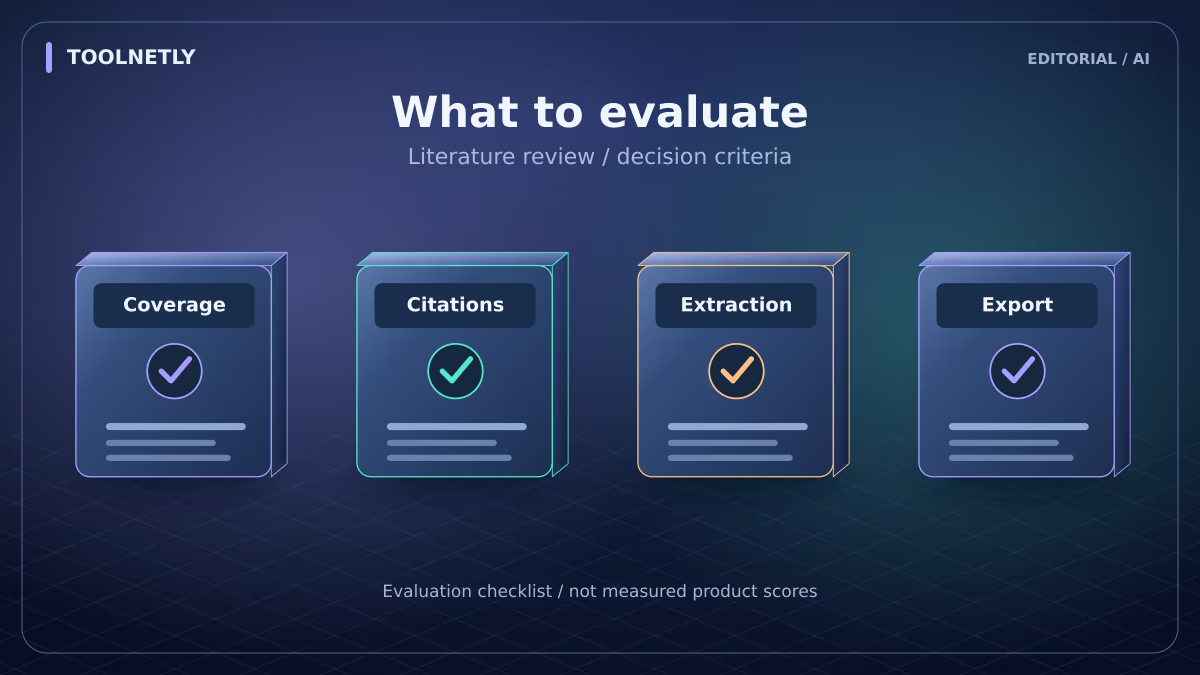
Evaluation criteria: Coverage, Citations, Extraction, Export. The illustration does not represent measured scores.
| Review stage | Useful tool to evaluate | Independent record to retain |
|---|---|---|
| Question formation | Consensus or Elicit | Written research question and scope |
| Database search | Library databases and Elicit | Search strings, filters and search dates |
| Connected-paper discovery | ResearchRabbit | Starting collection and new candidates |
| Citation appraisal | Scite | Source passage and your interpretation |
| Screening | Structured review workflow | Inclusion and exclusion decisions |
| Extraction | Elicit or a validated manual table | Values, units, source pages and reviewer |
The table describes possible roles. It does not establish that any product supplies complete database coverage or satisfies the requirements of a particular formal review.
A worked example: reviewing classroom retrieval practice
Imagine a researcher wants to understand whether retrieval practice improves examination results in university students. First, specify the eligibility criteria: population, study type, intervention, comparison and outcome. Define whether studies of short quizzes, delayed retention or final course grades are eligible. Record the date range and relevant languages.
Search the scholarly databases appropriate to the discipline. Use Elicit or Consensus to discover additional terminology and candidates. Record titles, identifiers and the search path. Remove duplicates before screening abstracts. If two publications report the same underlying study, avoid treating them as independent evidence.
Next, select a few known relevant studies and use ResearchRabbit to explore their citation network. Review newly discovered papers against the original criteria. Use Scite to examine how later publications discuss pivotal findings. A paper that mentions the same technique but examines a different outcome may be useful context, not an eligible study.
For included studies, extract sample size, comparison group, follow-up duration and the outcome in its original unit. If a study reports a difference in percentage points, do not convert it to a relative percentage without showing the calculation. If the data are absent, record them as not reported.
Finally, compare the evidence according to study quality and applicability. Avoid combining different outcomes as if they measure the same thing. A generated synthesis should cite the original sources and clearly distinguish established findings from your interpretation.
Create an evaluation protocol before choosing a subscription
Use a small set of papers with verified characteristics. Test discovery by checking whether known relevant papers appear. Test extraction by comparing selected fields against the publications. Test citation context by opening the original passages. Record errors, omissions and the time required to correct them.
Include a paper with an ambiguous abstract and one with an outcome reported only in a table. These cases reveal whether the workflow depends too heavily on easily available text. Do not infer that a tool has access to a full paper simply because it can display the title and abstract.
Check what you can export, whether the original identifiers are preserved and whether your institution has access to the documents. A useful workflow should allow a colleague to review the evidence even if they do not have the same subscription.
Frequently asked questions
What is the best free alternative to Elicit?
ResearchRabbit is worth considering for connected-paper discovery, and academic search tools may have free access options. Verify the current limits and the precise review stage you need. A free discovery service is not necessarily a replacement for structured extraction.
Is Consensus the same as Elicit?
No. Both can help researchers explore academic literature, but their workflows and outputs differ. Compare question-driven discovery and evidence organization with your own papers and current provider documentation.
Can Scite tell me whether a paper is correct?
It can help locate citation context, but you must evaluate the study's methodology and the arguments in the citing papers. A citation label does not establish scientific validity.
Can ResearchRabbit find every relevant paper?
No discovery method should be assumed to retrieve all relevant literature. Use appropriate database searches, several starting papers and a documented process.
Can AI automate a systematic review?
AI may support discovery, screening or extraction. Researchers remain responsible for the protocol, completeness, verification and reporting. Follow your institution's and publisher's requirements.
Official sources checked November 12, 2026: Elicit, Consensus, Scite, ResearchRabbit. This comparison is based on documented functions, not a systematic evaluation of database coverage.