

Which AI tools are best for research?
The right research tool depends on whether you are finding papers, reviewing a body of evidence, checking a citation or exploring a new topic. For academic literature, Elicit, Consensus, Scite and ResearchRabbit offer distinct approaches. A general AI assistant can help organize questions, but it is not a substitute for the original studies.
This guide compares documented capabilities, not a hands-on benchmark. Product information was checked against official sources on November 12, 2026. Verify current plans, data policies and access before using any service.
Compare research tools by task
| Tool | Useful starting point | What to check |
|---|---|---|
| Elicit | Find papers and organize evidence for a review | Database coverage, screening criteria and extracted values |
| Consensus | Explore a question using academic literature | Study designs and whether the answer reflects the cited papers |
| Scite | Investigate citation context and evidence | Read the surrounding passage, not just a citation label |
| ResearchRabbit | Discover related papers and authors | Whether the collection misses key fields or newer publications |
| Perplexity | Orient yourself in an unfamiliar topic | Open cited sources and distinguish scholarly evidence from websites |
| Claude | Structure your notes and analyze permitted documents | Check every quotation, calculation and reference |
These products solve different problems. Choose one for the first bottleneck in your work rather than subscribing to all six.
How can you trace a research claim back to its source?
Start with a question narrow enough to check against a study, such as whether spaced practice improves one-week vocabulary recall in adult language learners. Record the population, comparison group, and outcome before opening an AI tool. Use these details to decide whether a paper answers the question or simply shares keywords with it.
- In Elicit, search the question and record each promising paper’s DOI, study design, and measured outcome.
- In ResearchRabbit, start from a paper you have opened and follow citation links to find related studies. Track which paper led you to each result.
- In Scite, inspect how later papers cite the study. Read the original results section before labeling a claim supported, qualified, or still uncertain.
A practical literature search
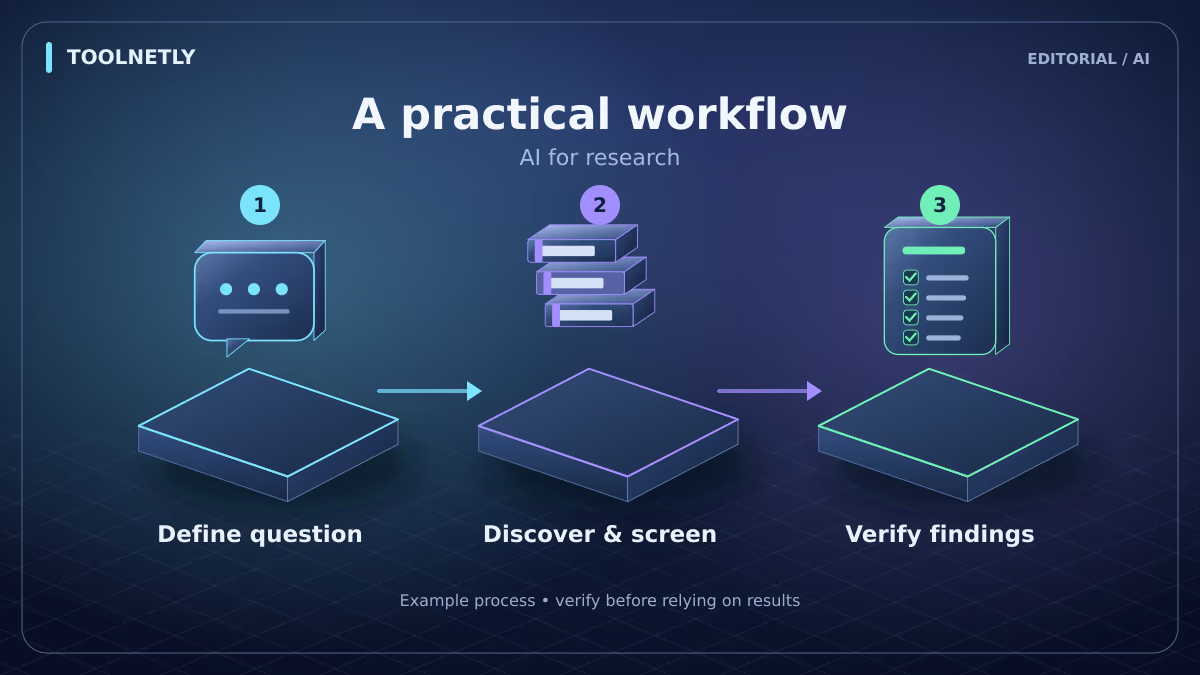
Define question → Discover & screen → Verify findings
Imagine you are preparing a review on whether retrieval practice improves long-term retention in university courses. Begin with a question that defines the population, intervention, comparator and outcome. Search for retrieval practice, practice testing and test-enhanced learning, recording the search terms and dates.
Start with an academic search tool such as Elicit or Consensus to locate candidate papers. Follow a few relevant papers in ResearchRabbit to discover related literature. Use Scite to investigate how a pivotal study has been discussed by later authors. Keep a separate spreadsheet with title, DOI, sample size, outcome, study design and inclusion decision.
Before summarizing, open the original publications and check the actual methods and results. A summary that confuses short-term recall with long-term retention can change the conclusion even when the citation is real.
How to evaluate AI research output
A useful evidence table should make it possible for another reader to trace every claim to a source. Include the page, section or table supporting important numbers. Mark information that is missing, rather than asking an assistant to fill the gap.
Run a small pilot using five papers you already know. Ask each candidate tool to locate the papers, identify the main result and report the sample size. Compare the outputs against the papers themselves. Record incorrect citations, omissions and the time required to correct each answer. This measures utility for your own research instead of relying on a generic accuracy claim.
For a formal systematic review, use an explicit search protocol, appropriate databases, reproducible inclusion criteria and independent screening when required. AI-assisted searches may help with parts of that workflow; they do not establish that the review is comprehensive.
Pricing, privacy and access
Free access can have search, document or export limits. Paid access does not guarantee that all journals are available. Check the provider's current pricing and whether your university offers access before buying. Avoid uploading confidential manuscripts, unpublished data or participant information unless your institution and the service terms permit that use.
Frequently asked questions
Can an AI research tool replace Google Scholar or library databases?
No single tool guarantees complete coverage. Use AI to discover, organize and inspect papers, and use scholarly databases and library resources appropriate to your discipline to reduce missed evidence.
Can I cite an AI-generated summary?
Usually you should cite the original publication for a scientific claim. Follow the publisher or institution's disclosure rules for AI assistance. Verify the source rather than citing a generated statement as if it were primary evidence.
Which tool should I try first?
For a structured literature review, start with Elicit. For related-paper discovery, try ResearchRabbit. For citation context, examine Scite. The best choice is the one that reduces a measurable bottleneck without lowering your evidence standard.
Build a research workflow that can be checked
Start by deciding what counts as a source for your question. A business researcher may use public company documentation, a historian may need primary records, and a clinical researcher may need peer-reviewed evidence. An AI search tool is useful only when its sources and outputs fit the project.
Write the research question in one sentence. Identify the outcome or concept you want to investigate and any scope restrictions. For an academic project, record the population, setting, period and study designs you intend to include. These decisions help you avoid treating every document that mentions the subject as relevant evidence.
Choose a discovery method
For a preliminary topic exploration, a search assistant can suggest terminology and point to sources. Perplexity may be useful for orienting yourself to a public topic. Ask for primary sources and follow the links yourself. A general web search may include blogs, product pages and secondary summaries; distinguish those from original research.
For academic literature, use the appropriate scholarly databases and consider a specialist such as Elicit or Consensus. Their role is to help identify and organize relevant work. Keep a record of search terms, filters and dates. Do not assume that any tool searches every relevant database or retrieves all eligible publications.
If the first search returns an overwhelming number of results, narrow the question or use more precise terminology. If it returns too few, identify synonyms from the relevant papers and consult a librarian or subject expert.
Map the related literature
Once you have a starting collection, explore related papers and authors using a literature-discovery tool such as ResearchRabbit. Begin with several sources from different groups. Record newly discovered candidates and how you found them.
Citation networks can help you notice a foundational paper or a later study, but they can also reinforce the perspective of the initial collection. Supplement network discovery with independent database searches and review reference lists. Do not treat the first cluster of papers as a representative sample of the field.
Check citation context and evidence quality
Scite can help identify how a paper is discussed in other publications. Open the cited and citing papers and read the relevant sections. A later author may support one finding while questioning another. Record the particular claim under discussion.
When deciding whether a study supports your conclusion, consider its design, measurement, sample and applicability. Distinguish correlation from causation. If a paper reports a result for a specific subgroup, do not automatically generalize to the whole population.
Organize evidence for a report
A general assistant such as Claude can help structure your notes into a draft when you supply permitted documents and verified findings. Ask it to use only your evidence table and flag missing information. Keep the original publications as the authoritative sources.
For an important number, require a page or table reference and preserve the original unit. Review the draft against your evidence record before sharing it. A well-written synthesis is not evidence of completeness.
An example evidence table
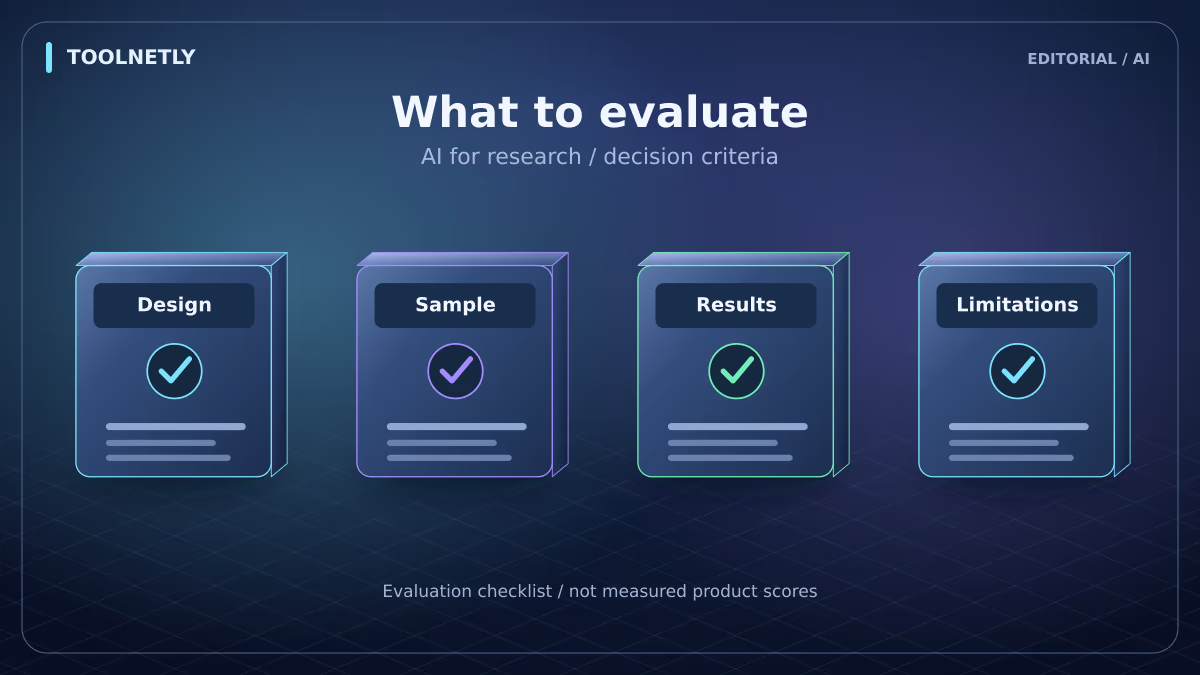
Evaluation criteria: Design, Sample, Results, Limitations. The illustration does not represent measured scores.
| Field | Example of what to record |
|---|---|
| Research question | Defined population, intervention and outcome |
| Source | Title, authors, year and DOI or stable link |
| Study design | Trial, observational study, review or other design |
| Sample | Number of participants and relevant characteristics |
| Result | Original numerical result, unit and uncertainty where reported |
| Source location | Page, table or section supporting the entry |
| Limitations | Important sources of uncertainty or restricted applicability |
| Decision | Include, exclude or investigate further, with reason |
This is a blank structure for your own evidence; it does not invent the results of any study. Store it in a format that can be shared with authorized reviewers independently of your AI account.
Compare products using a small known-paper test
Select five or ten papers you can access legally. Include a paper with a complicated table, one with terminology that has multiple meanings and one that is relevant only to a narrow population. First record the correct answers to the fields you want to extract.
Run each candidate tool against the same question. For discovery, check whether relevant known papers are retrieved. For extraction, compare every result with the original paper. For a synthesis, check whether it accurately preserves uncertainty and conflicting evidence. Include a question that the supplied papers cannot answer.
Record time spent checking and correcting the output. A tool that returns ten sources quickly may not be helpful if nine are irrelevant. Conversely, a slow, focused workflow may be valuable if it reduces later verification work.
Avoid common research errors
Do not cite a paper that you have only seen in an AI answer without confirming it exists. Do not accept a title, author list or DOI from generated text without checking the bibliographic record. Do not infer that a missing study means no evidence exists. Do not combine outcomes measured with different definitions unless your method justifies it.
For formal research, document your use of AI and follow institutional and publisher policies. If the work involves confidential participant data or an unpublished manuscript, check authorization and approved storage before uploading it. Do not ask a general tool to summarize an entire restricted dataset merely because an upload function is available.
For additional selection advice, compare Elicit alternatives, Perplexity alternatives and our ChatGPT vs Claude guide. Each covers a different part of a research workflow.
Additional questions from researchers
How do I choose between a general assistant and an academic search tool?
Start with the source type and deliverable. Use specialist discovery when you need scholarly literature, and use an authorized general assistant for organizing verified notes or drafting. You may need both, but only after identifying the actual bottleneck.
Can AI extract numerical data from papers?
Some tools can help extract structured information. Check values against the original table and preserve units, denominators and definitions. Record missing data as missing rather than filling it with a guess.
How should I handle conflicting studies?
Compare their methods, populations and outcomes. A contradiction may reflect different settings or definitions. Report uncertainty rather than forcing all results into one conclusion.
What if the tool cannot access a full paper?
Use your institution's lawful access or an available authorized version. Do not infer full-text results from an abstract. Record the access limitation in your review.
Sources and next steps
Official product information: Elicit, Consensus, Scite, ResearchRabbit, Perplexity and Claude.
Explore Research & Data AI tools, our AI tools for students guide and the AI data analysis guide for related workflows.