

What makes a useful Perplexity alternative?
Perplexity focuses on answering questions with links to sources and follow-up research. A suitable alternative depends on whether you want web research, a general assistant that produces work from your findings, or an academic literature search. The presence of citations alone does not prove that an answer is correct.
Compare alternatives by research task
| Tool | Best starting use | What to verify |
|---|---|---|
| ChatGPT | Research followed by writing, analysis or creation | Search availability, source fidelity, plan limits |
| Claude | Research and synthesis of supplied documents | Source access, quotation accuracy and permissions |
| Consensus | Finding answers grounded in scientific papers | Whether the studies apply to your question |
| Elicit | Literature discovery, screening and evidence extraction | Database coverage and extracted data |
Consensus and Elicit focus on academic research; they are not direct substitutes for every general web search. ChatGPT and Claude are broader assistants whose research features depend on the available plan and tools.
Evaluate source quality, not citation count
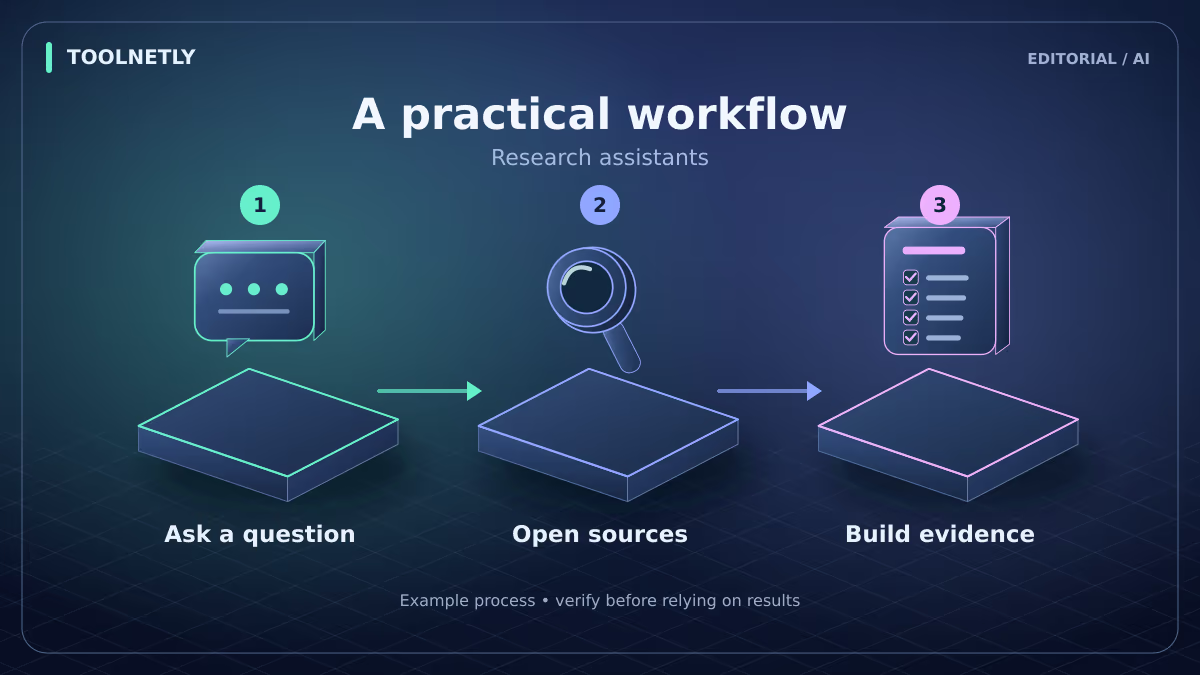
Ask a question → Open sources → Build evidence
Use a public research question such as whether a city changed its recycling rules in the past year. Ask each relevant web assistant to identify the date, official source and affected households. Open the municipal page and check its effective date. Mark unsupported statements as errors rather than accepting a citation that merely mentions recycling.
For scientific questions, use an academic tool and choose a narrower question with a defined population and outcome. Check the cited paper's study design and findings. A paper about a different population can be real and still fail to support the generated conclusion.
Compare workflow and cost
If you only need a quick source-oriented answer, a search assistant can be sufficient. If you need to turn research into a structured report, a general assistant may fit better. If you are conducting a literature review, prioritize reproducible paper discovery and evidence records.
Review official pricing, search limits, file handling, source exports and privacy policies. A paid plan does not establish that its citations are more reliable. Use non-confidential examples when testing.
Which should you try first?
For web research plus drafting, compare ChatGPT and Claude using identical prompts. For academic questions, try Consensus or Elicit. For literature mapping and citation verification, see our broader AI research tools comparison. Our ChatGPT vs Claude guide explains how to evaluate general assistants.
Compare the type of research you actually perform
A search-oriented assistant answers a question and points you toward evidence. A general assistant may help turn the evidence into a draft, table or analysis. An academic research product may focus on finding scholarly literature. These categories overlap, but they are not identical. A recommendation that treats every AI assistant as a search engine can mislead someone who needs a reproducible literature search.
List the deliverable before choosing a tool. Do you need a quick orientation to an unfamiliar topic, a sourced business brief, a summary of an approved document, or a scientific evidence table? The answer determines how much source coverage, traceability and export control you need.
ChatGPT: research followed by a deliverable
A general assistant can be useful when research is only the first stage of a task. For example, a project manager might need to investigate the current documentation for two services and then prepare a memo for colleagues. If the account supports search, start with the question and require links to the official pages. Then use only the verified facts to create the memo.
Compare how well the assistant preserves the distinction between a source's actual statement and its own inference. Ask it to mark anything that is not supported. Review the final memo yourself, especially any statement about prices, eligibility, deadlines or obligations. For more context, read ChatGPT vs Claude.
Claude: document-centered analysis
Claude is an option when your research begins with supplied documents rather than a broad web question. Prepare a public report and ask for a table of findings with page references. Include a detail absent from the report and check whether the assistant admits it cannot locate it.
If the work also requires current web sources, verify that the relevant search capability is available to your account. Keep a separate record of the sources you actually opened. A document assistant should help organize evidence, not become the authoritative source of facts that you cannot independently trace.
Consensus: question-driven scholarly exploration
For a question about the effectiveness of an educational intervention, Consensus may help you explore scientific studies. Formulate a question with a population and outcome, not simply a broad statement such as whether a technique works. Read the studies used to support the answer.
A search result can be relevant without being strong evidence. Compare study design, sample size, measurement and applicability. The conclusion of a small observational study is not interchangeable with a well-conducted controlled trial. Do not rely on a summary to establish causation.
Elicit: organizing evidence for a review
Elicit is worth evaluating if you need a structured literature workflow that involves screening papers or extracting information. Begin with a known set of relevant publications and check which ones the tool retrieves. Compare extracted study characteristics with the original tables and methods.
For a formal review, keep a reproducible search log and document inclusion and exclusion criteria. Use appropriate scholarly databases and independent review where required. Our Elicit alternatives guide explains how citation-context and literature mapping tools can complement that process.
A source-verification checklist
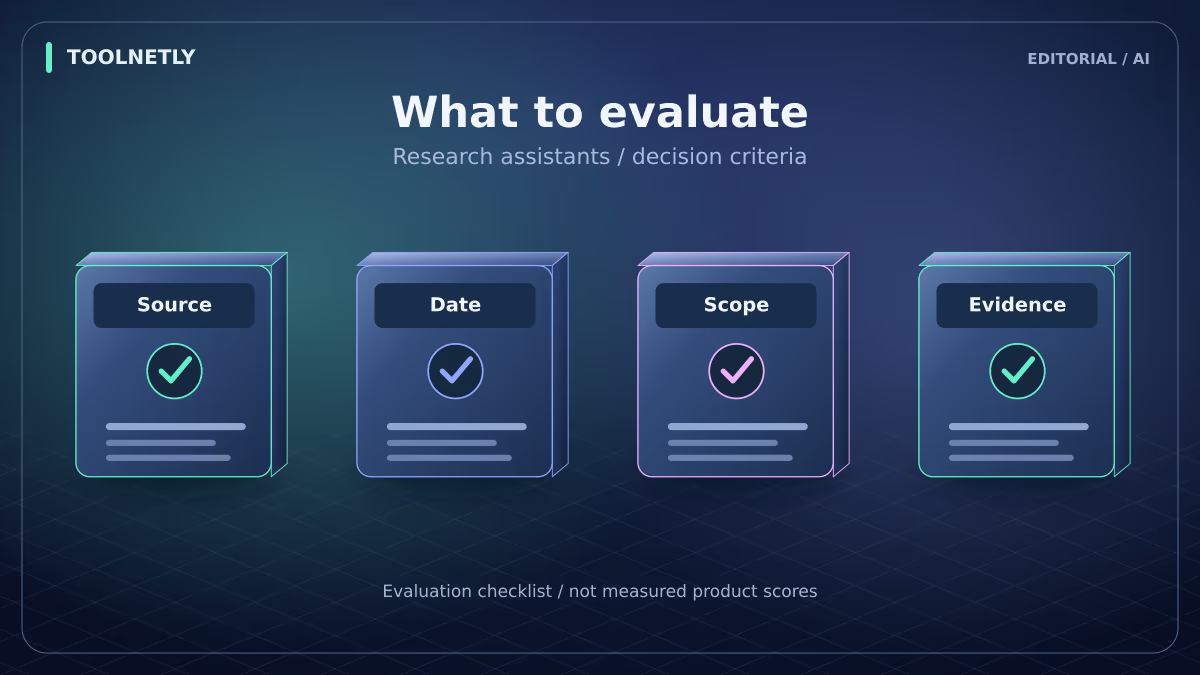
Evaluation criteria: Source, Date, Scope, Evidence. The illustration does not represent measured scores.
| Check | Question to ask | What to do if it fails |
|---|---|---|
| Source existence | Does the link open a real publication? | Mark the claim unsupported |
| Date | Is the information current for the question? | Find the relevant newer or historical source |
| Authority | Is the source competent to answer the question? | Prefer primary documentation or evidence |
| Claim fidelity | Does the cited passage support the exact statement? | Revise or remove the claim |
| Scope | Does it apply to the relevant country or population? | Narrow the conclusion |
| Independence | Are several links repeating the same source? | Look for genuinely separate evidence |
Citations are useful because they allow a person to check the reasoning. They should not be treated as decoration or as proof that the assistant is accurate.
Example: build a competitive research brief
Imagine a small business wants to compare three subscription services. Create a table with required integrations, account controls, supported export formats and current prices. Ask a search assistant to identify the official documentation for each product. Use the official sources to populate the table.
If a provider describes a feature without explaining which plan includes it, mark the field as unknown and consult the current plan comparison. Do not let the assistant infer availability from marketing language. Record the date you checked each field. A price from a year-old review may no longer apply.
Then ask a general assistant to turn the verified table into a short decision memo. Supply the exact constraints, including which fields remain uncertain. Review the result to ensure that it does not turn missing evidence into a positive or negative recommendation.
Compare privacy, access and workflow costs
If you are researching public information, a general search tool may be sufficient. If you need to analyze unpublished manuscripts, confidential proposals or internal notes, use only a service authorized for that information. Read the current data retention and training policies, and check whether your organization has a suitable plan.
Consider search limits, file upload limits, export formats and the time needed to verify the results. A tool that produces a faster answer may require more correction. A specialized academic product may justify its cost if it reduces a documented screening or extraction bottleneck. Test first on non-sensitive material and measure total time.
Frequently asked questions
What is the best free alternative to Perplexity?
A general assistant with search can be a starting point when available on your account. For scientific research, academic tools may offer limited free access. Check their current plans and choose based on the source type you need.
Does a cited answer guarantee accuracy?
No. The source may be real but unrelated, outdated or interpreted incorrectly. Open the original and compare the actual statement with the generated answer.
Can I use a general AI assistant for a systematic review?
It can help formulate questions and organize information. A formal systematic review still needs a documented search protocol, appropriate databases, screening and evidence appraisal.
Which option should I use for a report with confidential information?
Choose only a service and account approved for that information by your organization. Check data-use terms and avoid transmitting material beyond what is needed.
Should I use more than one research tool?
Often it is useful to combine a discovery tool with a source-checking or document-analysis workflow. Keep a single evidence record so you can trace the final claims. Using two AI assistants does not replace reading primary sources.
Preserve the evidence when you change tools
Before closing an account, export any permitted research notes and source lists you need to retain. Save the original publication links and the date you verified them, not just the assistant's final answer. An exported conversation may contain inaccurate statements or sensitive information, so review it before sharing. Rebuild your evidence table in a format that does not depend on access to a particular AI service. This makes future corrections and source checks easier.
Official sources checked November 12, 2026: Perplexity Search, ChatGPT, Claude, Consensus, Elicit. The recommendations describe workflow fit, not measured model rankings.